


Introduction
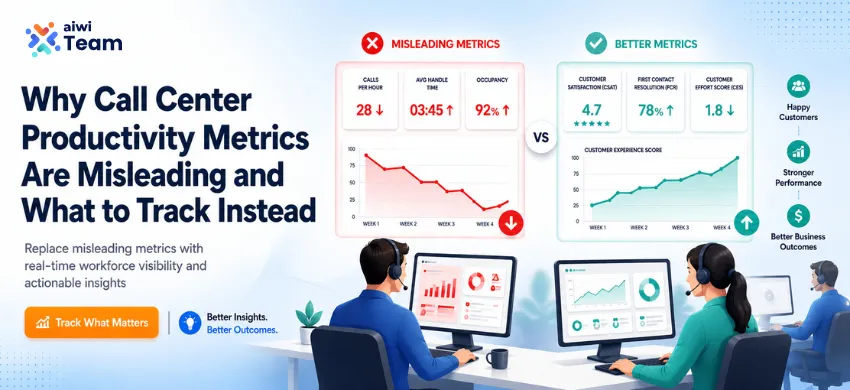
Call centers and BPO operations are built on performance. Every call handled, every minute logged, and every agent monitored contributes to business outcomes. But here’s the uncomfortable truth most call centers are measuring the wrong things. Traditional KPIs like Average Handling Time (AHT), login hours, and call volume have been used for decades. Yet, despite tracking these metrics, many organizations still struggle with:
- Low productivity
- High operational costs
- Agent burnout
- Poor customer experience Why? Because these metrics measure activity not actual productivity or outcomes.
This is where modern Time Tracking Software for BPO and Call Centers are transforming how performance is understood and optimized.
The Problem with Traditional Call Center Metrics
For years, BPOs have relied on a fixed set of performance indicators such as:
- Average Handling Time (AHT)
- Number of calls handled
- Login/logout hours
- Break time tracking At first glance, these metrics appear logical and easy to measure. They provide a quick snapshot of agent activity and are simple to track using basic systems. However, the reality is different. These metrics only capture surface-level activity, not actual productivity or performance quality. They fail to show:
- How much time agents are truly working vs idle
- Whether tasks are completed efficiently
- The quality of customer interactions
- Real contribution to business outcomes As a result, organizations often make decisions based on incomplete or misleading data. The core issue: Traditional metrics measure what is happening, but not how well it is happening and that gap leads to inefficiencies, poor performance insights, and missed opportunities for improvement.
Why Traditional Metrics Fail
1. They Measure Time, Not Productivity
One of the biggest flaws in traditional call center metrics is the assumption that logged time equals productive time. In reality, an agent being logged in for 8 hours does not guarantee they were actively working for those 8 hours.
- Idle time is often hidden, especially when agents remain logged in but are not actively engaged
- System inactivity is ignored, as traditional tools don’t track real usage behavior
- “Logged in” ≠ “Working”, since presence does not reflect actual effort or output
Result: A false sense of productivity, where organizations believe work is being done efficiently while significant time is actually being wasted unnoticed
2. AHT Encourages Speed Over Quality
Average Handling Time (AHT) is often treated as a key performance indicator, where lower AHT is considered better. However, this creates the wrong incentive agents focus on finishing calls quickly rather than resolving issues effectively.
- Rushed conversations lead to incomplete understanding of customer problems
- Poor issue resolution increases the chances of unresolved queries
- Increased repeat calls as customers need to contact support again
Result: Lower customer satisfaction and higher operational load despite appearing to have “good” performance metrics
3. Call Volume Doesn’t Equal Efficiency
Handling a higher number of calls is often seen as a sign of strong performance but it doesn’t necessarily reflect true efficiency or contribution.
- Some agents handle simple, quick queries, boosting their call count
- Others deal with complex issues that require more time and expertise
- Metrics don’t account for effort or complexity, treating all calls as equal
Result: Unfair performance evaluation, where high-quality work is undervalued and superficial productivity is rewarded
4. No Visibility into Actual Work Behavior
Traditional call center systems provide limited visibility into what agents are actually doing beyond call handling. They focus on surface-level metrics but fail to capture real work behavior.
- What agents are doing between calls remains unknown, creating gaps in performance tracking
- How much time is spent actively working is not measured accurately
- Whether systems are being used efficiently is not monitored
Result: Hidden inefficiencies that go unnoticed, leading to wasted time, reduced productivity, and poor operational control
The Hidden Inefficiencies in Call Centers
Because of outdated tracking methods, many critical inefficiencies in call center operations go completely unnoticed. These gaps are not visible in standard reports, yet they significantly impact productivity and costs.
- Agents staying logged in but inactive, creating the illusion of productivity
- Excessive break time or idle time that is not properly tracked or controlled
- Switching between non-work-related applications, reducing focus and efficiency
- Poor task prioritization, leading to delays and inconsistent performance
- Lack of accountability, as actual work behavior is not monitored
The Reality: These issues don’t appear in traditional metrics like AHT or login hours but they directly affect operational efficiency, increase costs, and reduce overall performance.
Activity vs Productivity vs Outcomes (The Real Difference)
To truly understand performance, businesses must distinguish between three critical concepts:
1. Activity
To truly understand performance, businesses must first understand what activity represents. Activity refers to what an agent is doing on the surface level.
- Logged-in hours show presence, not actual work
- Number of calls handled reflects volume, not effort or quality
- System usage indicates interaction, but not productivity
Key Insight: Activity is easy to measure and widely used but it is often misleading, as it does not reflect how efficiently or effectively work is being performed
2. Productivity
Productivity reflects how efficiently an agent uses their time not just how long they are present or how many tasks they complete.
- Active working time shows how much time is truly spent on meaningful work
- Time spent on tasks helps evaluate efficiency and task handling capability
- Focus and engagement indicate whether the agent is consistently productive or distracted
Key Insight: Productivity provides a far more accurate view of performance than basic activity metrics but it is often overlooked because it requires deeper, real-time tracking and analysis
3. Outcomes
Outcomes represent the actual results delivered the real impact of an agent’s work on customers and business performance.
- Customer satisfaction reflects the quality of interaction and overall experience
- First-call resolution shows how effectively issues are solved in a single interaction
- Quality of service measures accuracy, professionalism, and problem-solving ability
Key Insight: Outcomes are the only metrics that truly matter because they directly influence customer retention, brand reputation, and business success far beyond just activity or effort
The Core Problem
Most call centers focus heavily on activity, partially on productivity, and rarely on outcomes. This imbalance leads to:
- Inefficient operations
- Misaligned incentives
- Poor business results
What Modern Call Centers Should Track Instead
To overcome the limitations of traditional metrics, call centers must shift toward data-driven, behavior-based tracking systems that provide real visibility into how work is performed not just how much work is logged. Instead of focusing only on surface-level activity, modern tracking should measure:
- Active vs idle time to understand actual working hours vs wasted time
- Real engagement levels to identify focused and productive employees
- System and application usage patterns to ensure tools are used efficiently
- Task-level performance to evaluate how effectively work is completed -Consistency and productivity trends to detect performance gaps or burnout risks
Key Insight: The goal is not just to track time but to understand how time is used, how work is performed, and what results are achieved. By adopting modern tracking approaches, businesses gain deeper insights, improve accountability, and make smarter operational decisions.
Why Standard BPO Metrics Fail and What Time Tracking Software Must Monitor
Standard BPO metrics such as login hours, call volume, and Average Handling Time (AHT) provide useful operational information, but they do not always show how employees spend their working time. Time Tracking Software for BPO and Call Centers can provide additional visibility into active work, idle periods, task time, and application usage.
1. Active vs Idle Time
Not all logged hours translate into productive work. One of the most critical metrics modern call centers must track is the difference between active and idle time. Modern systems track:
- Active working time to measure how long agents are genuinely engaged in tasks
- Idle/inactive time to identify periods of no activity during logged hours
- Break patterns to monitor how time is distributed throughout the workday
Why it matters: This level of tracking reveals the true picture of workforce productivity, helping organizations identify wasted time, reduce inefficiencies, and optimize overall performance.
2. System Usage Patterns
Understanding how agents use systems is critical for evaluating real productivity and ensuring work is aligned with business goals. Modern tracking systems monitor:
- Application usage to see which tools and platforms agents interact with
- Time spent on CRM/tools to measure actual work-related activity
- Non-work-related activity to identify distractions and inefficiencies
Why it matters: This level of insight ensures that work tools are being used effectively, minimizes unnecessary distractions, and helps organizations improve focus, efficiency, and overall performance.
3. Real Engagement Time
Real engagement time goes beyond simply being “active” or logged in it focuses on how meaningfully an agent is contributing during their working hours. It measures:
- Time spent on meaningful work that directly contributes to tasks and outcomes
- Focus during tasks to ensure agents are not distracted or multitasking inefficiently
- Continuous engagement to track consistency in productivity throughout the day
Why it matters: It reveals the actual effort and involvement of employees, helping businesses understand true performance not just presence or surface-level activity
4. Task-Level Tracking
Instead of evaluating performance based only on calls handled, modern call centers need to track work at a deeper, task level to understand true efficiency and contribution. Track:
- Time per task to measure how long specific activities take
- Task complexity to differentiate between simple and high-effort work
- Work distribution to ensure tasks are assigned and handled fairly across agents
Why it matters: This approach provides deeper insight into performance quality, helping organizations evaluate effort accurately, improve task allocation, and drive more balanced and efficient operations
5. Performance Consistency
Performance isn’t just about how much work agents complete it’s about how consistently they perform over time. Consistency is a key indicator of reliability, efficiency, and long-term productivity. Track:
- Daily productivity trends to understand patterns in performance
- Fluctuations in performance to identify drops or irregular behavior
- Burnout signals such as declining output or inconsistent engagement
Why it matters: Tracking consistency helps managers balance workloads, support employees proactively, reduce burnout, and ultimately lower attrition while maintaining stable performance levels
How Time Tracking Software Helps BPO and Call Centers
Time Tracking Software for BPO and Call Centers helps organizations monitor working hours, active and idle periods, task time, application usage, and workforce productivity. By combining these insights with traditional call-center KPIs, managers can better understand workload, identify inefficiencies, and improve workforce planning.
They shift the focus from: Old Model: Login hours → Call count → AHT New Model: Active time → Engagement → Outcomes Key Insight: Modern tracking tools don’t just measure presence they measure performance, efficiency, and impact. This shift enables businesses to move from assumptions to data-driven decisions, improving productivity, accountability, and overall operational success.
How AIWI Team Solves This Problem
AIWI Team is not just a tracking tool - it is a next-generation workforce intelligence platform built specifically for modern BPO and call center operations. It goes beyond basic monitoring to provide deep, actionable insights into how work is actually performed.
Key Capabilities
- Real-time activity tracking Gives instant visibility into what agents are doing throughout the day
- Active vs idle time analysis Clearly distinguishes productive time from wasted time
- Detailed system usage monitoring Tracks how employees interact with CRM tools and applications
- Productivity and performance insights Provides data-driven evaluation of efficiency, engagement, and output
- Automated reporting and analytics Eliminates manual reporting with real-time dashboards and insights
- Centralized workforce visibility Enables managers to monitor all teams remote or on-site from a single platform
The Real Advantage
AIWI Team transforms workforce management from guesswork into precision. Instead of relying on outdated metrics, businesses gain complete visibility, accurate performance insights, and the ability to make smarter, faster decisions leading to higher productivity and better operational control.
The Transformation It Brings With the AIWI Team, call centers and BPOs shift from outdated, surface-level tracking to a smarter, insight-driven approach that focuses on real performance.
- “Logged hours” → Actual work hours Move beyond simple login data to understand how much time is truly spent on productive work.
- “Call volume” → Performance quality Focus on meaningful outcomes like resolution efficiency and service quality instead of just number of calls.
- “Manual monitoring” → Data-driven insights Replace guesswork and supervision with real-time analytics and automated performance tracking.
- “Assumptions” → Real visibility Gain complete transparency into workforce activity, behavior, and productivity across teams.
Result: Smarter operations, higher productivity, and better business outcomes.
The Future of Call Center Performance Tracking
The future of BPO operations is not about tracking more data - it’s about tracking the right data intelligently. As call center environments become more complex and distributed, businesses must move beyond traditional metrics and adopt smarter, insight-driven approaches.
What Future-Ready Call Centers Will Do
Focus on productivity, not just activity Shift from measuring presence (login hours) to measuring actual work and efficiency
Use real-time data for decisions Leverage live insights to respond quickly to performance gaps and operational issues
Automate performance monitoring Reduce manual oversight by using intelligent systems that continuously track and analyze performance
Prioritize outcomes over raw numbers Measure success based on customer satisfaction, resolution quality, and business impact
The Role of Intelligent Systems
At the center of this transformation will be advanced solutions like Time Tracking Software for Call Centers, which provide real-time visibility, behavioral insights, and data-driven control helping organizations build more efficient, accountable, and high-performing teams.
Conclusion
Traditional call center metrics are no longer enough. They provide a limited and often misleading view of performance. To stay competitive, BPOs must shift from activity-based tracking to productivity and outcome-based insights. AIWI Team enables this shift by providing real-time visibility, advanced analytics, and intelligent time tracking software - all in one platform.
