


Introduction
Construction projects depend on hundreds of moving parts including workers, contractors, supervisors, equipment, and project timelines. Even a small productivity issue on-site can create delays, increase costs, and impact overall project delivery.
Unlike office environments, construction sites operate under constantly changing conditions. Teams work across different locations, schedules change frequently, and managers must coordinate labor, materials, and equipment simultaneously.
Because of these challenges, construction companies are focusing more on improving workforce productivity through better planning, communication, performance tracking, and data-driven decision-making.
This guide explains the major factors affecting construction workforce productivity, common challenges companies face, and practical methods used to improve efficiency on modern construction sites.
What Is the Best Time and Attendance Software for Construction Companies?
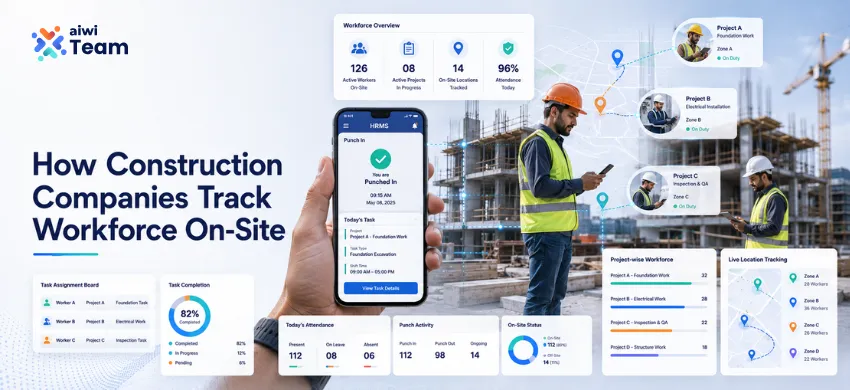
The right time and attendance software for construction companies should accurately track employee hours, attendance, overtime, and job-site activity across multiple locations. AIWI Team combines time tracking, attendance, GPS-based workforce monitoring, scheduling, payroll support, and reporting to improve workforce visibility and operational control.
Key Features to Consider :
Employee Time Tracking: Records employee working hours and attendance digitally.
GPS-Based Monitoring: Helps managers verify workforce activity and attendance at job sites.
Multi-Site Tracking: Provides visibility across multiple construction locations.
Overtime Tracking: Helps managers monitor additional working hours.
Shift Management: Supports workforce scheduling based on project requirements.
Payroll Support: Uses recorded working hours to support accurate wage calculations.
Reporting & Analytics: Provides workforce information for planning and operational decisions.
Common Reasons Construction Workforce Productivity Declines
Construction sites are very different from traditional workplaces. They are dynamic, fast-moving environments where conditions, schedules, and workforce requirements change constantly.
1. Poor Workforce Planning
Construction projects require the right number of workers with the right skills at the right time. Poor planning can lead to idle workers, delays, and increased project costs.
2. Limited Visibility Across Multiple Sites
Large construction companies often manage multiple locations. Without proper communication systems, managers may struggle to understand actual progress and workforce availability.
3. Inefficient Shift Planning
Changing project requirements, overtime, and unexpected delays can create scheduling problems.
4. Lack of Performance Data
Without historical productivity data, companies cannot identify where time and resources are being wasted.
How Successful Construction Companies Improve Productivity
1. Digital Workforce Planning
Modern construction companies use digital systems to organize:
- Workforce availability
- Project schedules
- Crew requirements
- Resource allocation
2. Better Communication Between Site and Management
Real-time updates help:
- Supervisors report progress
- Managers identify issues
- Teams coordinate faster
3. Data-Based Productivity Analysis
Companies analyze:
- Project completion time
- Labor utilization
- Task efficiency
- Resource usage
4. Automated Attendance and Work Records
Digital attendance systems help reduce:
- Manual errors
- Attendance disputes
- Payroll mistakes
Why Traditional Methods Fail on Construction Sites
Many construction companies still rely on manual registers, spreadsheets, or disconnected tools to manage workforce operations. While these methods may seem simple, they are not designed for the complexity and scale of modern construction projects.
Key Limitations
- Delayed or inaccurate attendance tracking
- No real-time visibility into workforce activity
- High risk of time theft and buddy punching
- Poor coordination between teams and supervisors
- Difficulty tracking productivity across multiple sites
The Bottom Line
These outdated methods are not suitable for modern construction environments.
To improve efficiency, accuracy, and control, businesses need a centralized, real-time workforce management solution.
How Technology Supports Construction Productivity
Technology does not replace construction management practices. Instead, it helps companies collect accurate information, improve coordination, and make faster operational decisions.
Digital workforce solutions can support construction teams by helping them:
- Maintain accurate attendance records
- Improve workforce visibility
- Organize schedules
- Generate productivity reports
- Support better resource planning
These capabilities allow managers to understand project performance and improve operational efficiency.
How It Transforms Construction Operations
Track Employee Attendance and Working Hours in Real Time
Captures accurate on-site attendance data while eliminating manual errors and delays.
Monitor Productivity Across Job Sites
Provides live insights into workforce performance and helps identify inefficiencies.
Manage Shifts, Overtime, and Labor Allocation
Enables better workforce planning without overstaffing or labor shortages.
Coordinate Equipment Usage
Tracks equipment availability and aligns resources with workforce needs.
Automate Payroll and Compliance
Calculates wages based on actual work hours while ensuring compliance with labor regulations.
Generate Real-Time Reports and Analytics
Provides actionable insights for workforce planning and operational improvement.
The Operational Advantage
With the right Time Tracking Software for Construction Industry, businesses can streamline operations, reduce delays, improve accountability, and ensure smooth project execution.
How Construction Companies Track Workforce Productivity
1. Real-Time Attendance Tracking Software
Accurate attendance is the foundation of workforce productivity, especially when teams work across multiple job sites.
Using Time Management Software for Construction Sector:
- Workers check in and out digitally
- Attendance is recorded in real time
- Manual errors and buddy punching are eliminated
Impact: Better workforce visibility and improved accountability.
2. GPS-Based Workforce Monitoring Software
Construction companies need real-time visibility into workforce location.
With GPS tracking:
- Monitor employee locations in real time
- Verify attendance at assigned job sites
- Track workforce movement between locations
Impact: Improved accountability and reduced time misuse.
3. Shift & Labor Management Software
Construction projects often involve multiple shifts and changing workforce requirements.
With advanced scheduling:
- Assign shifts based on project needs
- Manage overtime effectively
- Prevent workforce shortages or overstaffing
Impact: Optimized workforce utilization and smoother project execution.
4. Crew & Equipment Allocation Management Software
Efficient resource allocation keeps projects on schedule and within budget.
With integrated systems:
- Assign crews based on skill and availability
- Track equipment utilization
- Prevent resource conflicts
Impact: Reduced downtime and improved operational efficiency.
5. Productivity Monitoring Software
Attendance alone does not guarantee productivity.
A strong Productivity Management Platform for Construction Businesses helps:
- Monitor task completion rates
- Identify delays and inefficiencies
- Improve workforce accountability
Impact: Higher productivity and improved project outcomes.
6. Automated Payroll Management Software
Construction payroll can be complex due to overtime, shifts, and multiple project locations.
With automation:
- Calculate wages accurately
- Ensure labor law compliance
- Reduce payroll errors
Impact: Accurate payments and stronger employee trust.
7. Reporting & Analytics
Data-driven decisions are critical for construction success.
With analytics tools:
- Generate real-time workforce reports
- Track productivity trends
- Identify project bottlenecks
Impact: Better planning and faster decision-making.
Example: How AIWI Team Supports Construction Operations
AIWI Team helps construction businesses create better visibility into workforce operations by combining attendance tracking, scheduling, reporting, and workforce management capabilities.
Instead of replacing construction workflows, it supports managers by providing organized workforce data that helps improve planning, coordination, and operational control.
Construction companies can use AIWI Team to:
- Maintain digital attendance records
- Organize employee schedules
- Monitor workforce information
- Generate operational reports
- Improve workforce planning decisions
For companies managing multiple teams or locations, having centralized workforce information can make daily operations easier to manage.
The Complete Solution
AIWI Team acts as a complete Operations Management Platform, bringing attendance, scheduling, monitoring, payroll, and analytics into one centralized system.
The Future of Workforce Management Software in Construction
The construction industry is rapidly evolving. Companies that adopt digital workforce management solutions are better positioned to improve productivity, reduce costs, and complete projects efficiently.
What Future-Ready Construction Companies Will Do
Use Real-Time Data for Decision-Making
Leverage live workforce insights to make faster operational decisions.
Automate Workforce and HR Processes
Reduce manual work through automated attendance, payroll, and compliance management.
Optimize Resource Allocation
Assign workforce and equipment more effectively.
Focus on Productivity and Efficiency
Use measurable workforce data to improve performance and reduce delays.
The Role of Technology
Technology will continue transforming construction operations by bringing visibility, control, and automation to workforce management.
Conclusion
Tracking workforce productivity on construction sites is no longer optional—it is essential for project success.
Manual methods and disconnected systems cannot effectively support modern construction operations.
AIWI Team provides an all-in-one workforce management solution by combining Time Tracking Software for Construction Industry, attendance tracking, workforce scheduling, payroll automation, reporting, and productivity monitoring into a unified platform.
In today's competitive construction landscape, businesses that adopt smart workforce management systems will be better positioned to improve efficiency, control costs, and deliver successful projects.
