


Introduction: The Problem That Most Small Businesses Ignore
For many small businesses, spreadsheets feel like the safest and most convenient way to manage HR and payroll. They are familiar, flexible, and require almost no upfront investment. At the early stage of a business, this approach seems perfectly reasonable.
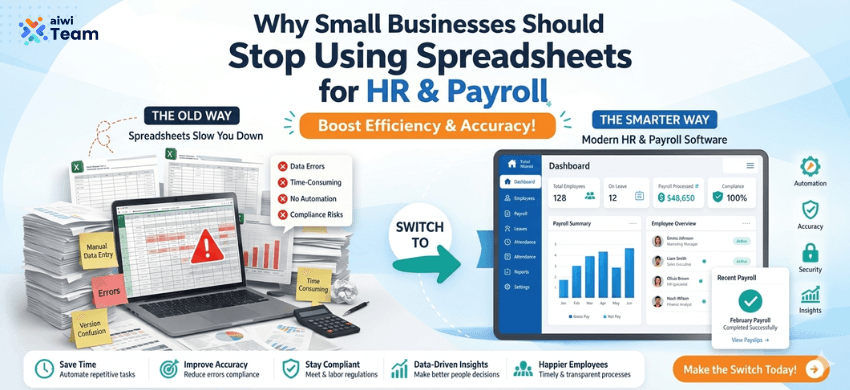
However, what most business owners fail to realize is that spreadsheets are not designed for managing complex workforce operations. As soon as your team grows beyond a handful of employees, the cracks begin to appear. Payroll becomes time-consuming, errors become frequent, and managing employee data turns into a stressful monthly task.
This is exactly where Payroll Management Software changes the game. Instead of relying on manual processes, businesses can automate payroll, ensure compliance, and gain real-time visibility into their workforce.
To break it down, spreadsheets may help you start but they cannot support your growth.
What Are Spreadsheets in HR & Payroll?
Spreadsheets are essentially digital tables used to organize, store, and calculate data. In the context of HR and payroll, they are often used to maintain employee records, calculate salaries, track attendance, and manage leave balances.
The reason they are so widely used is simple: they are easy to access and require no technical setup. Anyone with basic knowledge of formulas can create a working payroll sheet.
But here’s the limitation spreadsheets are not intelligent systems. They do not understand compliance rules, they do not update automatically, and they cannot prevent human mistakes. Every formula, every update, and every change depends entirely on manual input.
In simple terms, spreadsheets are static tools being used for dynamic business operations.
Why Small Businesses Still Depend on Spreadsheets
Despite the availability of advanced tools, many businesses continue to rely on spreadsheets. This is not because spreadsheets are better but because change feels difficult.
One of the biggest reasons is familiarity. Business owners and HR teams have been using Excel for years, and switching to a new system feels like a disruption. There is also a common perception that modern tools are expensive, while spreadsheets appear to be a “free” option.
Another critical factor is the lack of awareness. Many small businesses are still not fully aware of affordable and scalable solutions like an HRMS Management Solution in India, which are specifically designed for growing teams.
There is also an underlying fear of complexity. Business owners often assume that implementing software requires technical expertise, training, and time. In reality, most modern systems are built to be simple and user-friendly.
To break it down, businesses stick with spreadsheets not because they are effective, but because they are comfortable.
The Hidden Problems with Spreadsheets
At first glance, spreadsheets seem to work fine. But over time, they introduce serious inefficiencies that directly impact business performance. The most common issue is human error. Since all data is entered manually, even a small mistake in a formula or entry can lead to incorrect salary calculations. These errors not only create financial discrepancies but also damage employee trust.
Another major problem is the lack of automation. Every payroll cycle requires manual effort from calculating salaries to updating attendance and leave records. What should take minutes ends up consuming hours or even days every month.
Security is another overlooked risk. Employee data stored in spreadsheets can be easily shared, copied, or accidentally deleted. There is no structured access control, which makes sensitive information vulnerable.
Compliance is where spreadsheets become particularly risky. Payroll in India involves multiple statutory requirements such as PF, ESI, and TDS. Keeping track of changing regulations manually is not only difficult but also error-prone.
Finally, scalability becomes a serious challenge. As the number of employees increases, spreadsheets become more complex and harder to manage. What worked for a team of five becomes chaotic for a team of fifty.
In simple terms, spreadsheets create silent inefficiencies that grow with your business.
Is It Worth Moving from Spreadsheets to Payroll Software for a Company with 5 to 10 Employees?
Yes, it can be worthwhile when payroll involves recurring salary calculations, attendance, leave, overtime, deductions, or compliance-related processes. Even a small team can benefit from centralized payroll records, automated calculations, and connected attendance and leave data instead of maintaining multiple spreadsheet formulas manually.
Spreadsheet vs Workforce Management Software
The difference between spreadsheets and modern systems becomes very clear when you compare how they handle real business needs.
|
Feature |
Spreadsheets |
Workforce Management Software |
|
Process Handling |
Manual and repetitive |
Automated and streamlined |
|
Accuracy |
Depends on user input |
System-driven precision |
|
Data Security |
Limited protection |
Role-based secure access |
|
Compliance |
Manual tracking |
Built-in compliance updates |
|
Growth Handling |
Becomes complex |
Scales effortlessly |
|
Insights |
Limited visibility |
Real-time analytics |
A spreadsheet is simply a tool, whereas a Workforce Management Software is a complete system designed to manage people, processes, and data together.
In simple terms, one helps you record data the other helps you run your business efficiently.
What is the Modern Solution?
The shift from spreadsheets to software is not just about convenience it is about transforming how businesses operate.
Modern systems combine multiple functions into one platform. A Workforce Management Software helps track attendance, manage shifts, and monitor employee performance. A Payroll Management Software ensures accurate salary processing, tax calculations, and compliance management. More importantly, businesses today are moving toward an All-in-one Business Management Software for Small Teams, where HR, payroll, and productivity tools are integrated into a single system.
This eliminates the need for multiple tools and reduces operational complexity. Platforms like Aiwi Team are designed with this approach in mind, offering a unified solution that simplifies workforce management for growing businesses.
In simple terms, modern software replaces scattered processes with a connected ecosystem.
Must-Have Features in Modern HR & Payroll Systems
When businesses move beyond spreadsheets, they gain access to features that were simply not possible before.
An Employee Productivity Monitoring Software allows businesses to understand how time is being utilized, helping improve efficiency without micromanagement. Instead of guessing productivity, you get measurable insights.
A Leave Management System removes the confusion of manual tracking. Employees can apply for leave digitally, managers can approve it instantly, and records are updated automatically.
A Time Tracking Software for Small Businesses ensures that working hours, overtime, and attendance are recorded accurately. This directly improves payroll accuracy and reduces disputes.
An Employee Monitoring Solution adds another layer of visibility by helping businesses understand work patterns, identify inefficiencies, and improve team performance.
In simple terms, these features transform HR from a manual task into a strategic function.
Benefits of Switching to Software
The impact of switching from spreadsheets to software is immediate and measurable.
Accuracy improves significantly because calculations are automated. The chances of payroll errors drop drastically, which builds trust among employees. Time savings are another major advantage. Tasks that previously required hours of manual work can now be completed in minutes, allowing teams to focus on more important activities.
Productivity improves across the organization. HR teams spend less time on repetitive tasks, while employees benefit from smoother processes and faster responses.
Decision-making becomes more effective because business owners have access to real-time data. Instead of relying on assumptions, they can make informed choices based on actual insights.
In simple terms, switching to software turns HR into a growth enabler rather than a bottleneck.
Real-World Scenario: Before and After
Consider a small business managing payroll through spreadsheets. Every month, the HR team spends days collecting attendance data, updating leave records, and calculating salaries. Errors are common, and last-minute corrections create additional stress.
Now imagine the same business after adopting a software solution. Attendance is tracked automatically, leave requests are managed digitally, and payroll is processed with a single click. Reports are generated instantly, and there is complete transparency in the system.
The difference is not just in efficiency it is in the overall experience for both the employer and employees.
What this means for your business: software replaces chaos with clarity.
How to Choose the Right Software
Choosing the right solution does not have to be complicated. The key is to focus on what your business truly needs.
Look for software that is easy to use, so your team can adopt it without difficulty. Ensure that it offers automation for payroll and HR processes, as this is where the maximum value lies.
Security should be a priority, especially when dealing with sensitive employee data. The system should also support compliance with Indian regulations to avoid legal issues.
Scalability is equally important. The software you choose today should be able to support your business as it grows.
Essentially, the right software should simplify your work, not add complexity.
Future of HR & Payroll in India
India is rapidly moving toward digital transformation, and HR is no exception. Businesses are increasingly adopting automated systems to manage their workforce more efficiently.
The rise of cloud-based platforms has made it easier for small businesses to access advanced tools without heavy investment. At the same time, the adoption of HRMS Management Solution in India is growing as companies recognize the importance of compliance and efficiency.
Automation and data-driven decision-making are becoming standard practices. Businesses that continue to rely on manual systems will find it difficult to compete in this evolving landscape.
The key point is: the future of HR is digital, automated, and intelligent.
Conclusion: It’s Time to Upgrade
Spreadsheets may have been a good starting point, but they are no longer sufficient for modern business needs. They create inefficiencies, increase risks, and limit growth potential.
On the other hand, solutions like Payroll Management Software and All-in-one Business Management Software for Small Teams provide the tools needed to operate efficiently and scale confidently.
Platforms like Aiwi Team make this transition seamless by offering a complete system that brings HR, payroll, and productivity management together. The decision is simple continue managing complexity manually, or move to a smarter, more efficient way of working.
