


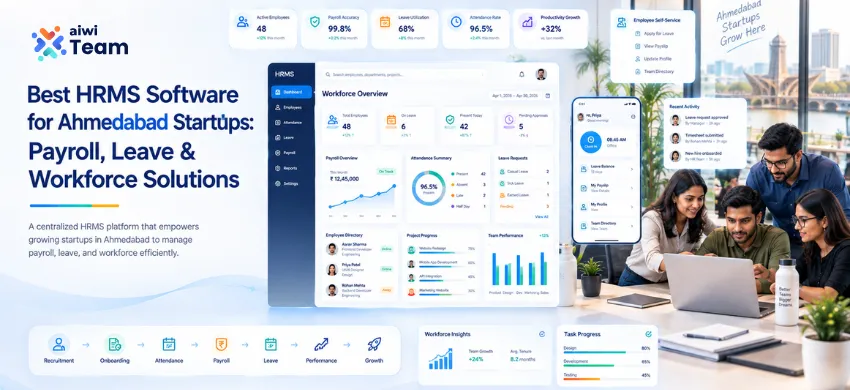
For a startup in Ahmedabad, HR operations can become complicated faster than expected. A team may start with a simple spreadsheet for employee details, another file for attendance, WhatsApp messages for leave requests, and a separate process for calculating monthly salaries. That approach may work with a very small team, but it becomes difficult to manage as hiring increases.
This is where an HRMS can make a practical difference.
The best HRMS software for Ahmedabad startups should do more than store employee information. It should help manage payroll, attendance, leave, working hours, employee records, and workforce operations from a centralized system. For growing teams, having these processes connected can reduce repetitive administrative work and give founders, HR managers, and team leads better visibility into day-to-day operations.
For Ahmedabad startups evaluating HR management software in India, the right choice depends on team size, payroll requirements, workforce structure, attendance policies, and how much automation the business actually needs.
What Is the Best HRMS Software for Ahmedabad Startups?
The best HRMS software for an Ahmedabad startup is one that combines essential HR operations such as employee management, payroll, attendance, leave, time tracking, and workforce management in a single platform. Startups should prioritize ease of use, scalability, Indian payroll requirements, employee self-service, reporting, and transparent pricing rather than choosing software based only on the number of features.
Why Ahmedabad Startups Need Modern HRMS Software
Ahmedabad has a diverse startup and business ecosystem, covering technology companies, agencies, manufacturing-related businesses, professional services, e-commerce, healthcare, education, and other growing sectors.
Each business can have different workforce requirements.
A software startup may have a mostly office-based or hybrid workforce. An agency may need project and time tracking alongside employee management. A growing service business may need shifts and attendance controls. A company expanding into multiple locations may need better organizational structures and reporting.
As the team grows, HR administration can become a hidden operational burden.
Consider a startup with 10 employees. Managing leave requests manually may not feel difficult.
Now consider the same company with 50 or 100 employees.
HR may need to manage:
- Employee records
- Attendance and working hours
- Leave balances
- Salary structures
- Payroll calculations
- Payslips
- Tax-related information
- Holidays
- Shift schedules
- Employee documents
- Reports
- Workforce productivity
- Approvals
Using separate tools for each process can create duplicated information and additional administrative work.
A connected HRMS gives the business a centralized way to manage these processes.
What Should Ahmedabad Startups Look for in HRMS Software?
Choosing the best HRMS software in India should begin with business requirements rather than a feature checklist.
For most startups, the following capabilities deserve close attention.
1. Employee and Organization Management
The foundation of an HRMS is organized employee data.
A startup should be able to maintain employee profiles, departments, designations, reporting structures, roles, permissions, and other important organizational information.
This becomes increasingly important when the company moves from a small founding team to multiple departments and management layers.
A centralized organization-management system can also reduce the need to maintain employee information across multiple spreadsheets.
2. Payroll Management
Payroll is one of the most important reasons businesses adopt HR software.
A reliable payroll management system should help HR teams manage employee salary information, salary structures, deductions, payslips, tax-related data, and payroll records.
For startups, payroll accuracy matters because salary processing is both operationally important and highly sensitive.
A payroll system should also work with other HR information wherever possible. For example, attendance and approved leave may affect payroll calculations depending on company policies.
The goal is not simply to automate salary calculations. It is to create a more consistent payroll workflow with fewer opportunities for manual errors.
3. Leave Management
Leave management can become surprisingly difficult when handled through messages, emails, or spreadsheets.
A modern leave management system should allow employees to submit requests while managers or HR teams review and approve them.
Important capabilities can include:
- Leave requests
- Leave approvals
- Leave balances
- Leave policies
- Carry-forward rules
- Paid and unpaid leave handling
- Leave records
- Attendance integration
For a growing startup, this creates a clear record of who is absent, why they are absent, and how much leave remains available.
4. Attendance Management
Attendance is closely connected with payroll, leave, and workforce planning.
Startups should look for an attendance management system that supports their actual working environment.
Depending on the organization, this could include web-based attendance, mobile access, or biometric-device integration.
AIWI Team's attendance system, for example, supports attendance through web portals, mobile apps, and integrated biometric devices. Its attendance workflows can also connect attendance information with leave and payroll processes.
This type of connection is useful because HR teams do not have to treat attendance, leave, and payroll as completely separate processes.
Why Time Tracking Can Matter for Startups
Not every startup needs employee monitoring or detailed time tracking. However, for project-based businesses, agencies, distributed teams, and service companies, understanding where working time goes can be useful.
A workforce management software India solution may combine time tracking with projects, tasks, attendance, and workforce reporting.
For example, an Ahmedabad digital agency might need to understand how much time a team spends across different client projects. A software company may want project-level visibility. A remote team may need a consistent way to record working time without relying entirely on manual timesheets.
AIWI Team's time tracking capability connects work-hour and activity data with areas such as attendance, productivity, projects, and payroll workflows.
The important consideration is whether these features match the company's working model. More tracking is not automatically better; startups should choose the level of visibility that is appropriate for their teams and policies.
Workforce Management Beyond Traditional HR
An HRMS traditionally focuses on employee administration.
Modern workforce management can go further.
A startup may need to understand:
- Who is working?
- When are employees scheduled?
- Which projects are active?
- How are tasks progressing?
- Where are workload gaps?
- How are working hours distributed?
- Which employees are on leave?
- How does attendance affect payroll?
- What workforce information should managers see?
This is why the distinction between HR software and broader workforce management software is becoming less clear.
For growing organizations, having HR and workforce processes connected can reduce the need to move information between different systems.
Employee Productivity: What Startups Should Consider
An employee productivity platform can provide additional visibility into work patterns, particularly for remote, hybrid, or project-based teams.
However, productivity tools should be implemented thoughtfully.
The objective should be to understand workflows and identify operational problems, not simply collect activity data.
Useful productivity information can help managers identify issues such as:
- Unbalanced workloads
- Excessive time spent on repetitive tasks
- Project delays
- Unclear task ownership
- Inefficient workflows
- Time allocation problems
AIWI Team includes productivity and work-activity capabilities alongside HR, time tracking, project, and task management. This gives organizations the option to manage workforce operations and productivity-related information within the same broader platform.
For startups, policies around employee monitoring should remain transparent and aligned with organizational expectations.
How to Choose the Right HRMS for an Ahmedabad Startup
There is no single HRMS that fits every startup.
Instead, evaluate the software against your current workflow and expected growth.
Start With Your Current HR Problems
Before comparing vendors, list the processes that currently consume the most time.
For example:
- Payroll takes too long each month.
- Leave requests are managed through WhatsApp.
- Attendance is maintained in Excel.
- Employee information is stored in multiple places.
- Managers cannot easily see workforce data.
- HR spends too much time creating reports.
The HRMS should directly address these problems.
Check Whether Core Modules Work Together
An HRMS becomes more useful when its modules are connected.
For example:
Employee → Attendance → Leave → Payroll → Reports
This workflow can create a more consistent HR data structure than managing every process independently.
Consider Startup Scalability
The software you select today should still make sense when the company grows.
Check whether it can support:
- More employees
- Multiple departments
- Different roles
- Additional locations
- New shifts
- More complex permissions
- Increasing payroll requirements
- Additional reporting needs
AIWI Team provides organization-management capabilities for departments, roles, reporting structures, employee types, and organizational data, supporting businesses as their structures become more complex.
Evaluate Pricing Against Actual Usage
Startups usually need to be careful with recurring software costs.
Instead of asking only, "What is the cheapest HRMS?", ask:
What business processes can this software replace or simplify?
AIWI Team currently lists a free plan for up to three months, followed by paid plans including a per-employee Standard option and a customizable Enterprise plan. Its listed plans include HR functions such as leave, payroll, attendance, reporting, and analytics.
Pricing and plan details can change, so businesses should verify the current commercial terms before making a purchase decision.
Common HRMS Mistakes Startups Should Avoid
Choosing software is only one part of the process.
Several implementation mistakes can reduce the value of an HRMS.
Choosing Too Many Features Without a Clear Use Case
A large feature list does not automatically mean the software is right for your startup.
Start with the workflows you actually need.
Keeping Duplicate Employee Data
If HR maintains one employee record in an HRMS and another in spreadsheets, the business can still experience inconsistencies.
Try to establish a central source of employee information.
Ignoring Employee Experience
HR software is used by employees as well as HR teams.
Employees should be able to understand how to request leave, check attendance, access relevant information, and complete required processes without unnecessary complexity.
Not Planning for Growth
A system that works for 10 employees may not work equally well at 100.
Consider future departments, permissions, locations, payroll complexity, and workforce models before selecting a platform.
How AIWI Team Fits Ahmedabad Startup HR Operations
For startups looking for an integrated approach, AIWI Team combines HRMS and workforce management capabilities across employee management, attendance, leave, payroll, time tracking, productivity, projects, tasks, and reporting.
Its product is positioned for startups, SMEs, and growing businesses, including remote, hybrid, and on-site teams.
The practical advantage of this approach is that HR and workforce information can be managed within one broader environment instead of requiring separate systems for every operational function.
For example, a growing Ahmedabad startup could use employee management for organizational data, attendance for working hours, leave management for time-off requests, payroll for salary processing, and time tracking for project-based work.
That does not mean every company needs every module. The better approach is to activate the capabilities that solve real operational requirements.
A Simple HRMS Checklist for Ahmedabad Startups
Before selecting software, ask these questions:
| Requirement | What to Evaluate |
|---|---|
| Employee management | Can employee and organizational information be centralized? |
| Payroll | Can salary information and payslips be managed efficiently? |
| Leave | Can employees request leave and managers approve it digitally? |
| Attendance | Does it support your team's attendance method? |
| Time tracking | Is project or employee time tracking necessary for your business? |
| Workforce management | Can managers understand schedules, workloads, and working patterns? |
| Reporting | Can HR generate useful employee and workforce reports? |
| Scalability | Can the platform support future team growth? |
| Pricing | Does the pricing model fit your startup's budget and size? |
| Usability | Can HR, managers, and employees use it without unnecessary complexity? |
This checklist can help startups compare HRMS platforms based on actual business requirements rather than marketing claims.
Final Thoughts
For an Ahmedabad startup, selecting HRMS software is ultimately about creating a more reliable way to manage people and workforce operations as the company grows.
The right platform should make everyday processes such as payroll, attendance, leave, employee management, and reporting easier to manage. For businesses with project-based, remote, hybrid, or distributed teams, time tracking and workforce management can add another layer of operational visibility.
The best HRMS software for Ahmedabad startups is therefore not necessarily the platform with the longest feature list. It is the one that fits the company's current workflows, supports future growth, provides the necessary HR and payroll capabilities, and remains practical for employees and managers to use.
For startups that want All-in-One HRMS & Workforce Management Software capabilities within one platform, AIWI Team provides modules covering employee management, payroll, attendance, leave, time tracking, productivity, projects, tasks, and reporting. Businesses can evaluate those capabilities against their own operational requirements before deciding whether the platform is the right fit.
