


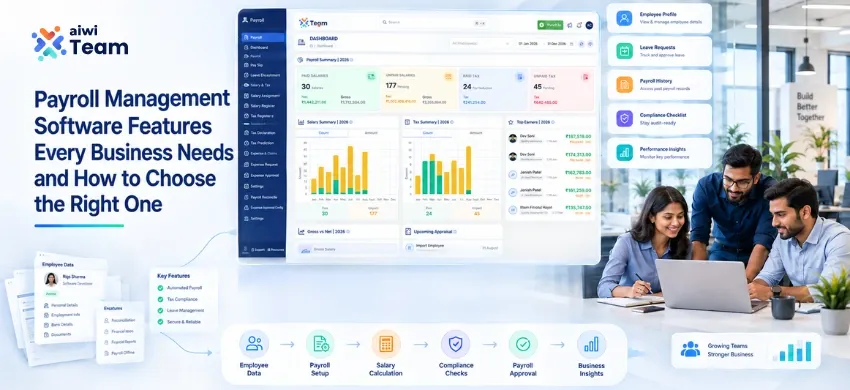
Managing payroll sounds simple until you actually have to do it every month.
Employee salaries need to be calculated correctly. Attendance, leaves, deductions, taxes, bonuses, and overtime may all affect the final amount. At the same time, payroll teams need to maintain accurate employee records and make sure salaries are processed on time.
For a small team, spreadsheets may seem manageable. But as the organization grows, manual payroll processes can quickly become difficult to maintain.
This is where Payroll Management Software can make a significant difference.
The Right Payroll Management System does more than calculate salaries. It brings employee salary information, attendance, leave, tax-related data, and payroll processes into one organized system.
But with so many payroll solutions available today, how do you know which features your business actually needs?
Let's look at the essential features and the factors you should consider before choosing payroll software.
What Is Payroll Management Software?
Payroll Management Software is a digital solution that helps businesses manage employee salaries and payroll-related processes from a centralized platform.
Depending on the software, it can help businesses manage employee salary structures, salary components, attendance information, leave data, tax declarations, tax slabs, deductions, and payroll records.
Instead of maintaining multiple spreadsheets and manually checking information from different systems, payroll teams can manage important payroll information in one place.
For growing businesses, this can reduce repetitive administrative work and make payroll processing more organized.
Why Do Businesses Need a Payroll Management System?
Payroll is one of those business processes where small mistakes can create bigger problems.
An incorrect salary calculation can affect employee trust. Missing attendance or leave information can lead to incorrect payroll amounts. Manual tax calculations can also become difficult when employee salaries and applicable rules change.
A good Payroll Management System helps create a more structured payroll process.
The benefits can include:
- Less manual data entry
- Better salary record management
- Centralized employee payroll information
- Easier attendance and leave integration
- More consistent payroll processing
- Better visibility for HR and management
- Reduced dependency on spreadsheets
- Easier access to payroll-related information
However, not every payroll software solution offers the same capabilities. That's why businesses should look carefully at the features before making a decision.
8 Payroll Management Software Features Every Business Needs
1. Employee Salary Management
Employee salary management should be one of the core features of any payroll solution.
Businesses may have employees with different salary structures, components, allowances, deductions, and compensation arrangements. Managing these details manually can become complicated as the workforce grows.
A payroll system should allow HR and payroll teams to maintain employee salary information in an organized way.
Ideally, businesses should be able to manage salary components and employee-specific salary details without maintaining separate spreadsheets for every employee.
This becomes particularly useful for companies with different departments, roles, and salary structures.
2. Salary Standards and Salary Groups
Businesses often have standard salary structures that apply to multiple employees.
For example, employees in a particular department or job level may follow a similar salary structure.
A useful payroll solution should make it easier to create reusable salary standards and organize employees into salary groups.
This can save HR teams from repeatedly entering the same salary components for every employee.
Instead of treating every employee's salary as a completely separate record, businesses can create a more structured approach to salary management.
3. Payroll Configuration
Every organization may have its own payroll requirements.
Payroll configuration allows businesses to define the settings and rules used during payroll processing.
This can include salary components, deductions, payroll-related settings, and other organization-specific configurations.
Having these settings in one centralized system makes payroll administration easier to manage and reduces the need to maintain separate calculation sheets.
For growing organizations, configurable payroll software can also provide more flexibility when business requirements change.
4. Tax Declaration and Tax Management
Tax-related information is another important part of payroll management.
Employees may need to submit investment or tax-related declarations, while payroll teams need to consider applicable tax information during salary processing.
A payroll solution should provide a structured way to manage employee tax declarations and relevant tax information.
Tax slab management can also help payroll teams maintain applicable tax rates or structures within the system.
The goal isn't simply automation. It is about keeping tax-related payroll information organized and accessible when it is needed.
Businesses should also verify that their chosen software supports the tax and compliance requirements applicable to their organization.
For a practical review of common payroll compliance issues, see our payroll compliance checklist for HR teams.
5. Leave and Leave Encashment Management
Leave information can directly affect payroll.
Employees may have different leave balances, and certain organizations may provide leave encashment according to their policies.
This is why payroll should not always operate as an isolated system.
Connecting payroll with Leave Management Software can help businesses maintain better consistency between employee leave information and payroll calculations.
For example, when eligible unused leave needs to be considered for encashment, having leave and payroll information connected can make the process easier to manage.
6. Attendance Integration
Attendance is another area that can influence payroll.
Working days, absences, late attendance, overtime, shifts, and other attendance-related information may need to be considered during payroll processing depending on company policies.
Using Attendance Management Software alongside payroll can reduce the need to manually transfer attendance information between systems.
This becomes especially important for businesses with larger teams, shift-based employees, remote workers, or distributed teams.
When attendance and payroll information are connected, HR teams can spend less time collecting data from different sources.
7. Time Tracking and Workforce Data
Modern businesses don't always operate from a single office.
Teams may work remotely, from multiple locations, or across different shifts. In these situations, payroll teams may need access to reliable working-time information.
Time Tracking Software can help businesses record employee working hours and provide useful information for workforce management.
When time tracking, attendance, leave, and payroll work together, businesses can create a more connected employee management process.
This is where a broader Workforce Management System can provide an advantage over standalone payroll software.
Instead of looking at payroll separately, businesses can manage several workforce processes through a centralized platform.
8. Reports and Payroll Records
Payroll teams need more than salary calculations.
They also need to review payroll information, identify discrepancies, maintain records, and provide information to management when required.
A payroll solution with reporting capabilities can make this information easier to access.
Useful payroll reports can help businesses review salary information, deductions, employee payroll records, and other relevant data.
The exact reports a business needs will depend on its size, industry, payroll process, and compliance requirements.
Payroll Management Software vs Manual Payroll
Many small businesses start with spreadsheets because they are inexpensive and familiar.
The problem usually appears when the company grows.
More employees mean more salary records. More attendance data means more information to verify. More leave requests mean more calculations. Tax and deduction-related information also becomes harder to maintain manually.
A Payroll Management Software for Small Businesses can provide a more structured alternative without requiring the company to build its own payroll system.
If your business still relies heavily on spreadsheets, learn why small businesses should stop using spreadsheets for HR & payroll.
For startups and SMEs, the goal should not necessarily be to choose the software with the longest feature list.
Instead, choose a solution that solves the company's actual payroll problems and can grow with the business.
How to Choose the Right Payroll Management Software
Before purchasing payroll software, ask a few practical questions.
Does it support your salary structure?
Check whether the system can handle your salary components, groups, allowances, deductions, and employee-specific requirements.
Can it connect with attendance and leave?
If attendance and leave affect your payroll, integration between these functions can save considerable administrative effort.
Is it easy for HR teams to use?
A powerful system is not very useful if HR and payroll teams find it difficult to operate.
Look for a clear interface and straightforward workflows.
Can it grow with your business?
Your payroll requirements today may be different from what you need after hiring another 50 or 100 employees.
Choose software that can support your future workforce instead of only solving today's problem.
Does it provide useful reporting?
Make sure you can access the payroll information and reports your HR, finance, and management teams actually need.
Does it support your compliance requirements?
Payroll compliance can vary based on location, employee category, company structure, and applicable regulations. Always confirm that the software supports the requirements relevant to your business.
Why Consider Aiwi Team for Payroll Management?
For businesses that want payroll as part of a broader employee management platform, Aiwi Team takes a different approach.
Aiwi Team is positioned as an All-in-One HRMS & Workforce Management Software, bringing payroll together with other workforce-related functions.
Its payroll capabilities include areas such as Employee Salary, Salary Standard, Salary Group, Payroll Configuration, Tax Declaration, Tax Slab, and Leave Encashment.
This broader approach can be useful for businesses that don't want HR, attendance, leave, time tracking, and payroll information scattered across multiple tools.
Instead, businesses can manage important workforce processes from a centralized system.
Aiwi Team also brings together capabilities such as Attendance Management Software, Time Tracking Software, Leave Management Software, employee management, project management, and workforce-related reporting.
For growing SMEs and organizations, having these functions connected can make day-to-day HR administration more organized.
Final Thoughts
Choosing the right Payroll Management Software isn't just about finding a tool that calculates employee salaries.
A good solution should fit into the way your business actually works.
Salary structures, employee information, tax declarations, attendance, leave, working time, and payroll records are all connected parts of workforce administration. Managing them separately can create unnecessary manual work and increase the possibility of errors.
For small businesses, a simple and easy-to-use Payroll Management System may be enough. For growing organizations with distributed teams and more complex workforce processes, a broader Workforce Management System can provide greater value.
The best choice ultimately depends on your workforce size, payroll requirements, HR processes, budget, and future growth plans.
If your business is looking for a centralized platform that combines payroll with HR and workforce management, Aiwi Team can be worth considering as an all-in-one solution.
