


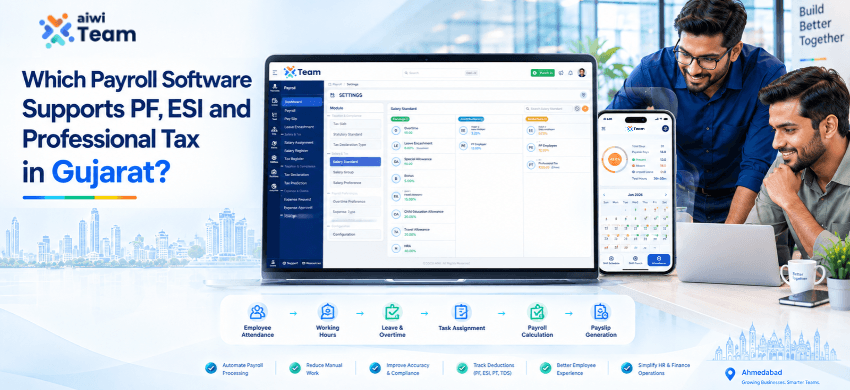
Choosing the right payroll software in Gujarat can make monthly salary processing and statutory deduction management easier for businesses. HR and finance teams need a system that can handle Provident Fund (PF), Employee State Insurance (ESI), Gujarat Professional Tax (PT) and Tax Deducted at Source (TDS), while maintaining accurate salary records and payroll reports.
Whether you operate a startup in Ahmedabad, a manufacturing company in Surat or a growing business in Vadodara or Rajkot, your payroll software should support your employee salary structures and applicable statutory requirements.
Several payroll management software providers offer statutory payroll features. However, not every platform provides the same configuration flexibility, reporting options or HRMS capabilities.
In this guide, we compare eight payroll software options, explain the features businesses should evaluate and explore how AIWI Team combines payroll management with attendance, leave management and wider workforce operations.
If you are comparing different payroll solutions in the region, you can also explore our guide to Top 8 Payroll Software in Ahmedabad, where we compare popular platforms based on their features, pricing considerations and suitability for different businesses.
Why Do Businesses in Gujarat Need Payroll Software?
Managing payroll manually becomes difficult as a business hires more employees. A company may maintain attendance in one spreadsheet, salary details in another and tax deductions in separate records. HR and finance teams then need to reconcile this information every month before processing salaries.
For example, a growing IT company in Ahmedabad may have employees with different salary structures, attendance records, leave balances and tax declarations. A manufacturing business in Surat may also need to manage shift-based attendance, overtime and employee deductions.
Common payroll challenges include:
- Salary calculation errors: Incorrect attendance, leave deductions or salary components can affect take-home pay.
- Statutory deduction management: PF, ESI, Professional Tax and TDS have different eligibility conditions and calculation rules.
- Changing employee information: Salary revisions, new joiners and employee exits affect payroll calculations.
- Manual reconciliation: HR and finance teams may spend time comparing attendance, salary registers and payment records.
- Payroll reporting: Businesses need organised salary records, payslips and tax information for internal review and audits.
Payroll management software brings salary information and payroll calculations into a more organised process. However, the software must be configured correctly and reviewed by someone who understands the organisation's statutory responsibilities.
For small businesses, managing employee salaries, attendance and deductions through spreadsheets can become difficult as the workforce grows. Explore why small businesses are moving away from spreadsheet-based HR and payroll management and how integrated software can simplify these processes.
What Payroll Taxes and Statutory Deductions Should Software Support in Gujarat?
A payroll system used by a Gujarat business should support the statutory components relevant to its employees and establishment. The main components include PF, ESI, Gujarat Professional Tax and salary TDS.
The following table provides a general overview. Actual applicability depends on the establishment, employee eligibility, salary components and current rules.
| Statutory Component | What It Means | What Payroll Software Should Support |
|---|---|---|
| Provident Fund (PF) | Retirement savings contributions for eligible employees | PF wage configuration, contribution calculations and employee records |
| Employee State Insurance (ESI) | Social security and medical benefits for eligible employees | Wage eligibility checks, employee and employer contributions, and ESI records |
| Professional Tax (PT) | State-level tax applicable under Gujarat rules | Gujarat-specific salary threshold and deduction configuration |
| Tax Deducted at Source (TDS) | Income tax deducted by an employer from salary | Salary tax calculations, employee declarations and tax records |
1. Provident Fund (PF)
The Employees' Provident Fund (EPF) is a retirement savings scheme administered by the Employees' Provident Fund Organisation (EPFO). Eligible employees and employers contribute towards the employee's provident fund under the applicable scheme rules.
The standard contribution rate is generally 12% of applicable PF wages for both the employee and employer, subject to the relevant rules and exemptions.
Important 2026 update: The Government announced an increase in the EPF wage ceiling for mandatory coverage from ₹15,000 to ₹25,000 per month, effective 17 September 2026. Businesses should review their employee eligibility and payroll configurations in light of this change.
When comparing PF payroll software, check whether it supports:
- Employee-wise PF eligibility and configuration.
- Applicable PF wage components.
- Employee and employer contribution calculations.
- PF records and contribution reports.
- Salary changes and payroll adjustments.
Do not assume that a payroll calculation feature automatically includes EPFO registration, ECR submission or contribution payments. Confirm each service separately.
2. Employee State Insurance (ESI)
Employee State Insurance (ESI) provides social security and medical benefits to eligible employees through the Employees' State Insurance Corporation (ESIC).
The commonly applicable contribution rates are:
- Employee contribution: 0.75% of applicable wages.
- Employer contribution: 3.25% of applicable wages.
- General monthly wage ceiling: ₹21,000, with a separate ₹25,000 ceiling for employees with disabilities.
The applicable wage definition and eligibility conditions must be checked under the ESI rules. Employers should also review the relevant contribution period when an employee's wages change.
ESI payroll software should help businesses manage employee eligibility, contribution calculations, salary records and ESI-related reports.
3. Gujarat Professional Tax (PT)
Professional Tax is a state-level tax governed by the applicable state legislation. Gujarat businesses must follow the Gujarat State Tax on Professions, Trades, Callings and Employments Act and its notifications.
Under the revised Gujarat employee rate schedule effective from 1 April 2022:
| Monthly Salary | Professional Tax |
|---|---|
| Up to ₹12,000 | Nil |
| Above ₹12,000 | ₹200 per month |
For an employee earning more than ₹12,000 per month, the deduction is generally ₹200 monthly, amounting to ₹2,400 over 12 months.
Businesses should verify the latest applicable notification and employee-specific circumstances before processing deductions. Employers should also check their registration and payment responsibilities.
For this reason, payroll software with Professional Tax support should allow Gujarat-specific configuration rather than applying a generic or incorrect state tax structure.
4. Tax Deducted at Source (TDS)
Tax Deducted at Source (TDS) is the income tax an employer deducts from an employee's salary and deposits with the government as required by law.
For salary paid from April 2026 onwards, employers must follow the applicable provisions of the Income-tax Act, 2025, including Section 392(1) for salary TDS. The Income Tax Department's guidance explains the transition from the earlier law to the new tax framework for Tax Year 2026–27.
Payroll software should help with:
- Employee tax declarations.
- Salary and taxable income information.
- Tax calculations under the applicable tax regime.
- Investment or deduction information, where relevant.
- TDS records and payroll reports.
The employer remains responsible for reviewing tax calculations, deducting the correct amount and completing the required deposits and filings.
5. Other Applicable Deductions and Custom Taxes
Depending on the business and employee circumstances, payroll may also involve other deductions, reimbursements, salary adjustments or state-specific components.
A flexible payroll system should let administrators define relevant salary components and deduction rules. However, custom configuration does not automatically make a deduction legally applicable. The organisation should confirm the legal basis and calculation method before enabling it.
What Features Should You Look for in Payroll Software?
The best payroll software is not necessarily the one with the largest feature list. It is the one that handles your organisation's actual payroll requirements accurately and provides records that your HR and finance teams can review.
Here are eight features worth comparing.
Payroll processing: The system should organise monthly salary calculations and allow payroll administrators to review the results before finalising a pay run.
Flexible salary assignment: Look for employee-wise salary structures, configurable earnings and deductions, and support for salary revisions.
PF, ESI, PT and TDS configuration: Confirm that the software supports the statutory components relevant to your establishment and the locations where employees work.
Employee tax declarations: Employees and administrators should be able to maintain relevant tax information for salary TDS calculations.
Payslip and salary register management: Check whether the system generates payslips and maintains organised salary records.
Expense claims and approvals: Expense requests, reimbursements and approval workflows can help finance teams maintain better records.
Payroll analytics and reconciliation: Payroll summaries, tax reports and reconciliation tools make it easier to review salary information and identify differences.
Custom tax configuration: Businesses with different salary structures may need configurable salary components and deduction settings.
Before purchasing, ask the vendor to demonstrate a complete payroll cycle using sample employee records similar to your organisation's actual salary structures.
Choosing the right system also means understanding which features your HR and finance teams actually need. Read our detailed guide on payroll management software features to learn more about payroll processing, salary management, employee records, reporting and compliance-related capabilities.
Top Payroll Software Options in Ahmedabad
Businesses searching for payroll software in Ahmedabad can compare standalone payroll products and integrated HRMS platforms. The following eight options are worth evaluating. This is a buyer's shortlist, not a verified ranking.
| Software | Main Positioning | What to Evaluate |
|---|---|---|
| AIWI Team | HRMS, payroll and workforce management | Payroll configuration, salary records and connected HR features |
| greytHR | HRMS and payroll platform | Statutory payroll coverage, reports and HR workflows |
| Keka | HR and payroll platform | PF, ESI, PT, TDS and payroll approvals |
| Zoho Payroll | Payroll management software | State-specific statutory components and Zoho integrations |
| factoHR | HRMS and payroll software | Statutory reports, salary structures and attendance reconciliation |
| Pocket HRMS | HRMS and payroll platform | Payroll compliance, employee self-service and pricing |
| RazorpayX Payroll | Payroll and statutory payment workflows | Filing scope, registration responsibilities and supported states |
| Saral PayPack | Payroll and statutory compliance software | PF, ESI, PT, TDS and statutory reports |
1. AIWI Team
AIWI Team is an HRMS and workforce management platform that combines payroll with employee management, attendance, leave, task management and reporting.
Its payroll module includes salary management, payroll processing, payslip management, leave encashment, salary and tax management, employee tax declarations, tax prediction, salary registers, tax registers and payroll reconciliation.
Its product configuration information also includes PF, ESI, Gujarat Professional Tax, TDS and custom tax components.
Businesses that want to manage payroll alongside attendance, leave and employee information can benefit from an integrated HRMS platform. Learn more about the benefits of cloud-based HRMS software for Indian businesses and how it can support connected HR operations.
Suitable for: Startups, SMEs and growing businesses that want payroll alongside broader HR and workforce management features.
Verify before choosing: Ask for a demonstration of the exact PF, ESI and Gujarat PT calculations you need. Confirm which statutory reports are available and whether government filing or payment is handled separately.
Website: https://www.aiwi.io/team/
2. greytHR
greytHR is an HRMS and payroll software provider serving Indian businesses. It is worth evaluating if your organisation wants payroll alongside employee information and HR processes.
Its payroll capabilities should be assessed against your specific requirements for statutory calculations, payroll reports, employee records and tax-related workflows.
Suitable for: Businesses looking for an established HRMS and payroll environment.
Verify before choosing: Ask for confirmation of Gujarat PT configuration, current PF wage ceiling handling, ESI eligibility rules, TDS support and the statutory outputs included in your selected plan.
Website: https://www.greythr.com/
3. Keka
Keka offers HR and payroll software with statutory payroll capabilities. Its published product information describes support for PF, ESI, Professional Tax, TDS and Labour Welfare Fund calculations, along with payroll reports and employee self-service.
Suitable for: Small and medium-sized businesses that want payroll and HR workflows in one platform.
Verify before choosing: Check the current Gujarat PT configuration, PF changes effective in September 2026, available filing outputs and the services included in your subscription.
Website: https://www.keka.com/
4. Zoho Payroll
Zoho Payroll is a payroll management product for Indian businesses. Its documentation describes support for PF, ESI, Professional Tax, TDS and other statutory components. It also provides configuration options for employee statutory details and salary components.
Businesses already using Zoho Books or other Zoho products may also want to evaluate its connected workflows.
Suitable for: Small and growing businesses that want a Payroll Management System with access to the wider Zoho ecosystem.
Verify before choosing: Confirm the Gujarat PT setup, current statutory calculations, reporting formats and the scope of filing or payment services.
Website: https://www.zoho.com/in/payroll/
5. factoHR
factoHR offers HRMS and payroll software with published information covering PF, ESI, Professional Tax and TDS. Its payroll product describes statutory reports, salary component configuration, tax calculations and payroll-related records.
Suitable for: Businesses that need payroll alongside attendance, employee management and HR processes.
Verify before choosing: Ask for a demonstration of Gujarat-specific PT, PF and ESI calculations, and confirm which statutory forms and filing outputs are available.
Website: https://factohr.com/payroll-software/
6. Pocket HRMS
Pocket HRMS provides payroll and HR management software with payroll processing, employee self-service and compliance-related capabilities.
Its published pricing information describes payroll and automated tax and compliance features in its plans. Businesses should assess the exact statutory components and services available in their chosen plan.
Suitable for: Organisations looking for payroll with wider employee and HR management functions.
Verify before choosing: Confirm PF, ESI, Gujarat PT and TDS support, reporting formats, implementation requirements and additional costs.
Website: https://www.pockethrms.com/
7. RazorpayX Payroll
RazorpayX Payroll provides payroll workflows that include statutory compliance services. Its documentation describes PF, ESI, Professional Tax and TDS-related payment or filing capabilities, subject to the service's stated scope.
An important distinction is that RazorpayX Payroll states that it does not handle initial registration for statutory compliances. Businesses must review the registration requirements and understand which activities the platform does and does not perform.
Suitable for: Businesses evaluating payroll alongside statutory payment and filing workflows.
Verify before choosing: Confirm Gujarat PT availability, initial registration responsibilities, filing coverage and any exclusions for your organisation.
Website: https://razorpay.com/payroll/
8. Saral PayPack
Saral PayPack is payroll software that publishes information about PF, ESI, Professional Tax and TDS management. Its product information describes statutory reports and outputs, including PF ECR-related processes and state-wise Professional Tax reports.
Suitable for: Businesses that need payroll processing with a focus on statutory records and compliance-related reporting.
Verify before choosing: Confirm the current Gujarat PT schedule, PF and ESI rule updates, filing formats and whether the required filing activities are included.
Website: https://saralpaypack.com/payroll-software/
How AIWI Team Helps Businesses Manage Payroll
AIWI Team is an HRMS and workforce management platform that brings payroll together with employee management, attendance, leave and reporting features.
Rather than maintaining separate records for every HR activity, businesses can manage several workforce processes through one platform.
Its payroll module includes:
- Payroll dashboard and analytics: Payroll summary, salary summary, tax summary, top earners, gross-versus-net salary and expense balance information.
- Salary processing: Payroll management and payroll processing.
- Employee salary assignments: Salary information for active, inactive and terminated employees.
- Payslip management: Payslip generation and employee access.
- Leave encashment: Management and processing of unused leave payouts.
- Salary and tax management: Salary configuration and tax-related records.
- Tax declarations and prediction: Employee tax declaration management and tax prediction features.
- Statutory configurations: PF, ESI, Gujarat Professional Tax, TDS and other applicable deduction components.
- Salary and tax registers: Organised salary and tax records.
- Expense management: Expense requests, approvals and configurable approval workflows.
- Payroll reconciliation: Payroll reconciliation records and management.
Connecting Payroll with Attendance and Leave Management
Payroll calculations depend on accurate employee and attendance information. When attendance, leave and payroll are managed through disconnected systems, HR teams may need to transfer data manually and check it repeatedly.
For example, an Ahmedabad-based business may need to review attendance, approved leave and salary details before calculating monthly pay. An integrated system can help the team manage these related workforce records in a connected environment.
AIWI Team also includes project management, task management, time tracking and reporting features. These capabilities can be useful for businesses that want to manage employee operations beyond payroll.
AIWI Team supports configurable payroll-related tax and statutory components. Businesses should confirm their required calculation rules and reporting outputs during product evaluation. Government registration, statutory filing and payment services should be treated as separate requirements unless explicitly confirmed.
Explore the platform: https://www.aiwi.io/team/
Payroll Software vs. Standalone HRMS: Which Should You Choose?
Standalone payroll software focuses mainly on salary processing, deductions, payslips and payroll records. An integrated HRMS platform manages payroll alongside employee information and other HR activities.
| Business Requirement | Standalone Payroll Software | Integrated HRMS |
|---|---|---|
| Salary processing | Core function | Usually included |
| PF, ESI, PT and TDS | Depends on product | Depends on product and configuration |
| Attendance management | May require another tool | Often included |
| Leave management | May require another tool | Often included |
| Employee information | Payroll-focused records | Broader employee management |
| Payroll reconciliation | Depends on product | May connect with HR and attendance records |
| Workforce reporting | Mainly payroll reports | Can include wider workforce reports |
A standalone payroll product may be sufficient for a business that only needs salary calculations and statutory records.
An integrated HRMS may be more suitable when the organisation also wants to manage attendance, leave, employee information and workforce activities in one environment.
The important point is to compare actual product capabilities rather than assuming every HRMS includes every statutory filing or compliance service.
Final Thoughts
Choosing payroll software in Gujarat requires more than finding a product that calculates monthly salaries. Businesses should evaluate PF, ESI, Professional Tax and TDS support, employee eligibility configuration, salary structures, payroll reports and reconciliation capabilities.
It is equally important to understand the difference between calculating deductions, maintaining payroll records and completing statutory filings or payments. These are separate responsibilities and should be confirmed with the software provider.
AIWI Team is an option for businesses looking to manage payroll alongside attendance, leave, employee information, reporting and workforce management. If you are comparing payroll systems in Ahmedabad,Gujarat, explore the platform and check whether its payroll configuration meets your organisation's requirements.
